Temperature: Hot, off the wok
Where: Chifa
Price range: S/12–40
What it is
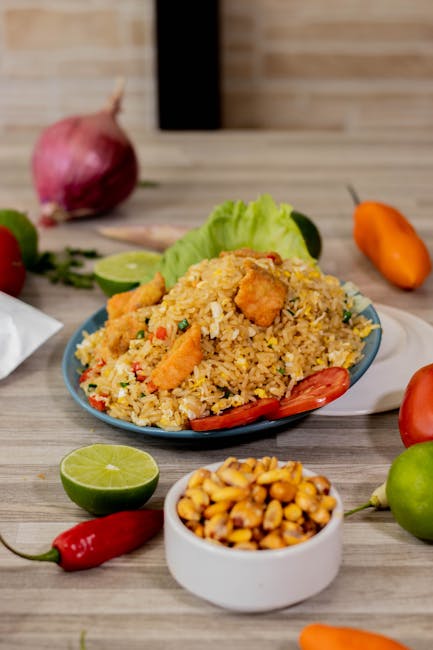
Arroz chaufa is the Peruvian-Cantonese fried rice that's on the menu of every chifa (and a great many sangucherías, sit-down restaurants, and street stalls) in Lima. The recipe is fundamentally Cantonese — day-old white rice fried hard in a screaming-hot wok with garlic, soy sauce, scrambled egg, scallions, ginger, and a protein — but the protein, the heat level, and the side accompaniments are unmistakably Limeño.
The standard Lima version, arroz chaufa de pollo, comes piled into a deep plate or a Chinese-style takeout container, and arrives with: the rice (slightly oily, with little flecks of egg and dark soy color), a side of salsa de tamarindo or sweet-and-sour, and — almost always — a small bowl of wantán soup (clear broth with a few wonton dumplings) on the side. The wonton soup is part of the meal, not an upsell.
Why try it
Arroz chaufa is the cheapest reliable hot meal in Lima — a generous plate at a barrio chifa runs S/12–18 and is sized for two normal people or one hungry one. It is the dish that fed Lima students, taxi drivers, and night-shift workers through the 1990s and 2000s, and it is still the default lunch order at the chifa on the corner.
It's also the easiest entry point into Lima's chifa culture. Where some chifa dishes (like kam lu wantán or aeropuerto) require a bit of explanation, arroz chaufa is universally legible. If you've eaten Cantonese fried rice anywhere, you know what's coming — but the soy is darker, the wok hit is harder, and the egg is more generous than in most international versions.
How to order it
"Un arroz chaufa de pollo, por favor." (One chicken fried rice, please.)
Variants:
- Arroz chaufa de pollo — chicken. The default. S/12–22.
- Arroz chaufa de carne — beef. S/14–25.
- Arroz chaufa de chancho — pork (often char siu style). S/14–22.
- Arroz chaufa especial / mixto — combination of chicken, beef, pork, sometimes shrimp. S/18–32.
- Arroz chaufa de mariscos — seafood. S/22–40.
- Aeropuerto — chaufa + tallarín saltado on the same plate, named for the way the food piles up like luggage at LIM. The deep-cut order. S/22–35.
In any chifa, the "combinado" is a generous half-and-half of arroz chaufa + another dish (usually tallarín saltado or kam lu wantán) at a price between two solo plates and one. Often the best value.
What it should cost
| Where | Plate (S/) | Combo with soda (S/) |
|---|---|---|
| Barrio chifa (Centro, Surquillo, Magdalena) | 12–18 | 18–25 |
| Mid-range chifa (Madam Tusan, San Joy Lao) | 25–40 | 35–55 |
| Upmarket chifa | 40–70 | 55–95 |
Rule of thumb: a barrio chifa charges roughly the same for a plate of arroz chaufa as it does for a menú del día. They are direct competitors.
How to eat it
- Mix it with a spoon, not chopsticks. Limeños eat chifa with cutlery. Chopsticks are brought only on request and mostly for tourists.
- The salsa de tamarindo on the table is for the wantán fritos. Not for the rice.
- Add a little soy sauce if the rice tastes flat — most chifas have a small bottle on the table. Don't drown it.
- Pair with a Coca-Cola or Inca Kola. Almost no one orders beer with chifa during the day.
- Order a small "porción de wantán frito" as a side if you have appetite — fried wontons with sweet-and-sour, S/8–15.
Where to try it
- Centro de Lima — Calle Capón (Barrio Chino, between Jr. Andahuaylas and Jr. Paruro): the historic chifa zone. Salón Capón, Wa Lok, and San Joy Lao are all here. Walking distance from Plaza Mayor.
- Madam Tusan (Miraflores) — Av. Santa Cruz 858. Gastón Acurio's polished chifa. Excellent chaufa especial.
- Chifa Titi (San Isidro) — Av. Javier Prado Este 1212. Founded 1957, family-run, one of the oldest still operating.
- Chifa Chung Tong (Surco): Av. Benavides 3590, with eleven versions of chaufa on the menu. (See our place ficha.)
- Any neighborhood chifa in Surquillo, Magdalena, Lince, or Jesús María — pick the one with the most office workers at lunch.
For more on the format, see our chifa concept page.
Origins
Arroz chaufa is one of the founding dishes of chifa — the Peruvian-Cantonese cuisine born in the 19th century when roughly 100,000 Cantonese coolíes (indentured laborers) arrived in Peru between 1849 and 1874 to work on the coastal plantations and railways. When their contracts ended, many migrated to Lima, opened small fondas (eateries) in Calle Capón and surrounding streets, and adapted Cantonese recipes to local ingredients. Day-old rice — fundamental to the technique — became cheap to source as Lima's rice consumption grew, and the soy sauce, wok, and ginger paste arrived with the immigrants themselves.
The word "chaufa" is a limeñización of the Cantonese 炒飯 (chǎo fàn), literally "fried rice". The dish stabilized in Lima between 1900 and 1940, and by the 1950s there were already over 6,000 chifas in Peru. Today, a generation of nisei chefs (notably the Hsieh family at Madam Tusan) have re-elevated the dish — but the canonical version is still the one served at a barrio chifa for S/15.
Related
- Chifa — the restaurant format that exists for this and a hundred related dishes.
- Nikkei fusion — the other great Asian-Peruvian cuisine.
- Peruvian Food 101 — the wider dish list.
- Menú del día — the equivalent budget meal at a non-chifa restaurant.
- How to order food in Lima — phrases for chifas and casual restaurants.