Temperature: Hot, off the wood-fired rotisserie
Where: Pollería
Price range: S/22–65 per person
What it is
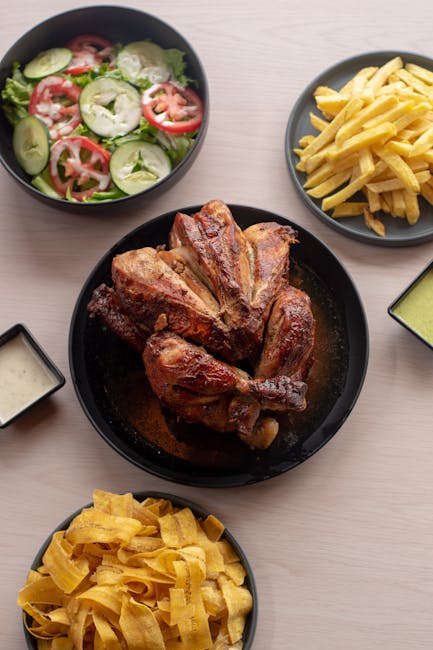
Pollo a la brasa — also called pollo a las brasas or just pollo broaster by some — is Peru's national dish by sheer volume of consumption. Roughly 1.5 million chickens are eaten this way every Sunday in Lima alone. The dish is a whole chicken marinated in beer, soy sauce, garlic, cumin, huacatay (Andean black mint), ají panca and a closely guarded blend of spices, then roasted whole on a vertical skewer in a rotating wood-fired or charcoal oven for around 70 minutes. The skin comes out mahogany and lacquered, the meat juicy and smoky, and the bird is hacked into quarters with a cleaver and served with French fries, a small salad, and a battery of sauces.
The standard order is un cuarto de pollo con papas y ensalada — a quarter chicken with fries and salad. The chicken arrives with two to four sauces on the table: crema de ají amarillo, crema de huacatay verde, mayonesa, and sometimes a smoky ají rocoto or ají panca. Pickled onions or salsa criolla often arrive too.
Why try it
Pollo a la brasa is the Lima Sunday dinner. It's the dish that kept the country together through the 1980s, when other foods got expensive and a polleria meal still fit a working family's budget. There is a reason every district has at least one polleria and Limeños have strong opinions about which is theirs.
For the traveler, pollo a la brasa is the lowest-risk, highest-value dinner you can have in Lima. It's:
- Universally clean (the chicken is cooked at high heat for over an hour).
- Universally affordable — even the upmarket chains charge S/30–55 for a generous quarter-chicken meal.
- Always open — pollerías run 12:00 to 23:00 most days, no reservation needed.
- Kid-friendly — chicken and fries; no surprises.
If you only have one "casual local dinner" night in Lima, this is the one. Skipping it because it sounds basic is the second most common rookie mistake (after skipping anticuchos).
How to order it
At the counter or to the waiter, the canonical order is:
"Un cuarto de pollo con papas y ensalada, por favor." (A quarter chicken with fries and salad, please.)
Variants you'll see on the menu:
- 1/4 de pollo (a quarter) — typical solo portion. S/22–38 depending on the polleria.
- 1/2 pollo (half) — for two people or one very hungry one. S/40–65.
- 1 pollo entero (whole) — for 3–4 people, almost always cheaper per gram than buying quarters.
- Pierna (leg) or pecho (breast) — specify if you have a preference. Pierna is juicier; pecho is milder.
- Combo familiar — a whole chicken + fries + salad + 1.5L Inca Kola, S/85–120 — feeds 3–4.
Drinks at a polleria are almost universally Inca Kola (the canonical pairing) or Coca-Cola. Beer where available. Fresh juices at the better places. No one orders wine.
What it should cost
| Where | 1/4 chicken meal (S/) | Whole chicken combo (S/) |
|---|---|---|
| Neighborhood polleria | 22–32 | 70–95 |
| Chain (Norky's, Roky's, Pardo's) | 30–45 | 90–120 |
| Upscale polleria (La Leña, La Granja Azul) | 40–60 | 130–180 |
A meal for one at any decent polleria is S/30–45 with drink. Anything under S/20 is suspicious; anything over S/60 a quarter is paying for the room.
How to eat it
- Hands or cutlery, no judgment. Limeños use a fork-and-knife on the breast and switch to fingers for the thigh.
- The sauces matter. Try the chicken plain first to taste the marinade. Then experiment with each sauce — the ají amarillo and huacatay are not garnish, they're integral.
- Fries dipped in ají amarillo + mayo is the canonical combo; mix them in equal parts on your plate.
- The salad is mostly there to cut the richness. It's often iceberg + tomato + a sliver of beet — uninspired but functional.
Where to try it
Pollerías to know in Lima:
- La Leña — multiple branches, the most respected mid-upscale chain. Sons of the original founder still run it. Avenida Benavides branch in Miraflores is reliable.
- Pardo's Chicken — the polished chain, opened 1986 by Arnold Wu. Branches in every district. Slightly upscale; the chicken is consistent.
- Norky's (founded 1976) and Roky's (founded 1985) — the two big mainstream chains. Roky's is generally considered better.
- La Granja Azul (Av. La Marina) — old-school, since the 1960s, all-you-can-eat polleria; a Lima institution.
- El Rancho (Surco) — local favorite; the rotisserie is on display.
- Tip-top — barrio polleria found in Jesús María, San Borja, and Surquillo; smaller, cheaper, often better.
For more on the format and history, see our polleria concept page.
Origins
Pollo a la brasa was invented in 1950 by Roger Schuler, a Swiss-Peruvian living in Chaclacayo (a town 30 km east of Lima), at his country house "Granja Azul". Schuler experimented with roasting chicken on a horizontal spit over wood coals and developed the marinade — beer, garlic, cumin, ají panca, huacatay — that defines the dish to this day. His business partner Franz Ulrich later patented the rotating vertical oven ("rocoto" oven) in 1956, which became the standard polleria oven worldwide.
The first commercial polleria in Lima was Schuler's "La Granja Azul", which opened to the public on the same Chaclacayo property and is still operating in 2026. The dish exploded in popularity in the 1970s and 80s, and the third Sunday of July was declared Día Nacional del Pollo a la Brasa by Peru's Ministry of Production in 2010, citing the dish's status as Peru's most-eaten meal — over 130 million chickens roasted this way per year nationally.
Related
- Polleria — the restaurant format that exists for this dish.
- Peruvian Food 101 — the ten dishes every traveler should try.
- Miraflores food guide — La Leña and Pardo's branches in Miraflores.
- How to order food in Lima — phrases for pollerías and casual restaurants.